


THE RELATIONSHIP BETWEEN FASHION AND ARCHITECTURE. BUT WHY SHOULD WE CARE?
- Jan 15
- 5 min read
Second Skin, Third Skin
Let's begin with Maslow’s hierarchy of needs. At the very bottom of the pyramid, alongside food and water, sit two humble necessities: shelter and clothing. Humans are predictable creatures. Once we stop freezing to death, we immediately begin to express ourselves. Survival is efficient; expression is inevitable.

Shelter evolves into architecture, while clothing transforms into fashion, often described as the “second skin.” Architecture, meanwhile, occupies the role of the “third skin”. Both protect the body, both communicate identity, and both perform aesthetic labor long before we consciously register it.
Yet key distinctions separate them. Fashion is a seasonal desire, driven by production and consumption. Architecture, by contrast, aspires to permanence and endurance. Still, somewhere between material, proportion, and creative intention, the they meet, argue, borrow ideas, and quietly inspire one another.
This is not a coincidence. Through the history, we witnessed how architectural thinking has long shaped fashion, just as architecture has absorbed fashion’s aesthetic. The concern is not whether fashion and architecture are connected, but why this relationship matters.
Build The Dress
Fashion turns architectural when it becomes preoccupied with structure rather than surface and where design is defined by how materials are assembled, not merely how they appear.
“Fashion is architecture; it is a matter of proportions.” - Coco Chanel
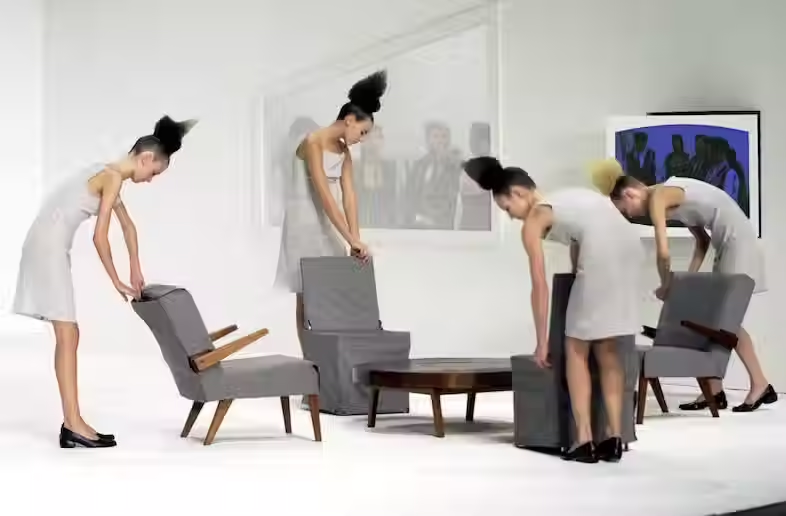
It is what Hussein Chalayan did at London Fashion Week in February 2000, Afterwords collection, where furniture transformed into garments, collapsing domestic architecture into wearable form. The theme focused on architecture, aerodynamics, space, combining philosophical ideals with wearable clothes. As Suzy Menkes observed in The New York Times, “It was a stellar performance.”

Gianfranco Ferré, who was often described as “the architect of fashion”, approached garments in terms of structure and geometric precision to generate sculptural volume, turning clothing into a study of proportion and construction.


Designers have translated architecture into fashion in radically different ways. Gianni Versace treated garments like façades, symmetry, and ornament until clothing became spectacle. Rei Kawakubo does the opposite, dismantling the body as fashion’s center. Her distorted volumes collide with anatomy rather than flatter it, echoing deconstructivist architecture’s embrace of imbalance and rupture. Between excess and refusal, Virgil Abloh approached fashion as an architectural system of signs and references, while Tom Ford distilled structure into discipline, using clean lines and controlled proportions to prove that architecture can also mean restraint. Added to the list contemporary innovators, Iris van Herpen uses 3D-printed, biomorphic garments resemble wearable architectures shaped by process rather than tradition.


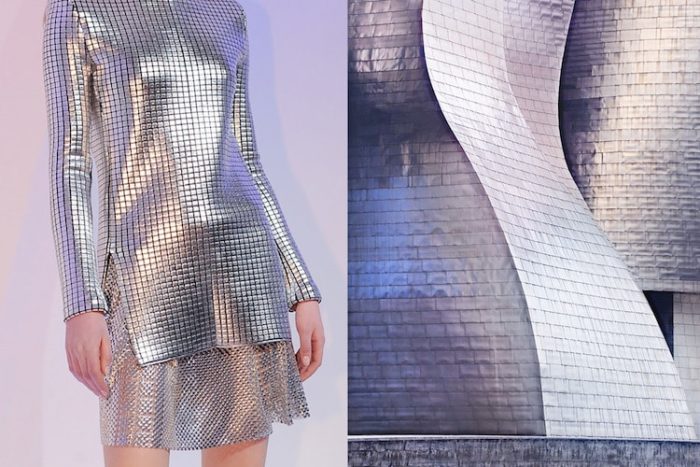

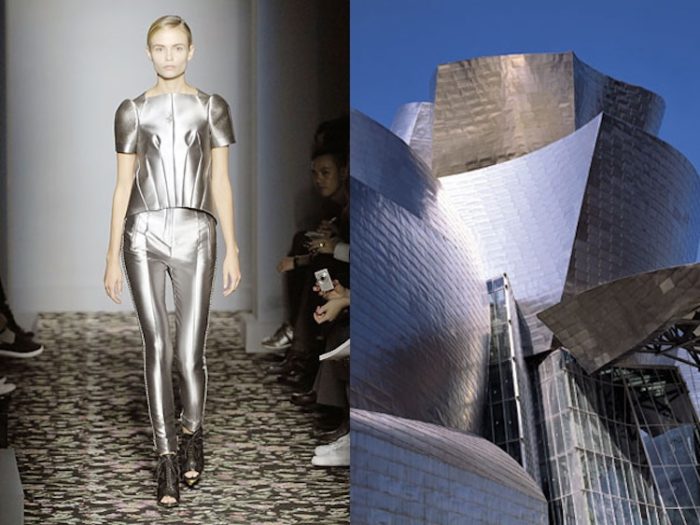

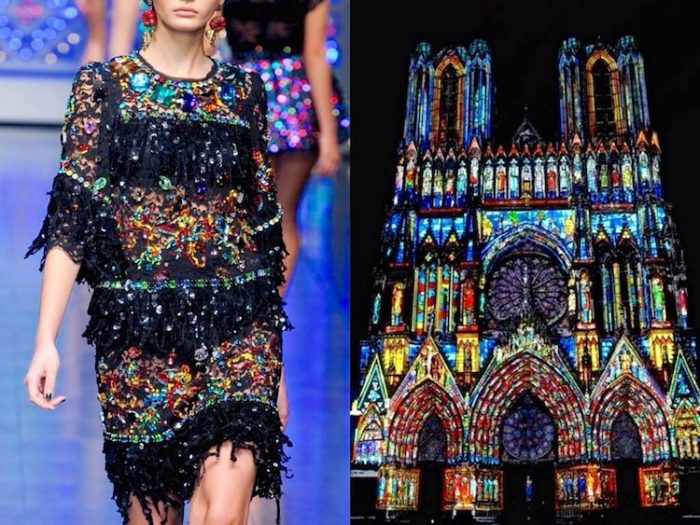
Here, fashion does not borrow architecture’s image; it adopts its methods. Clothing becomes a temporary building for the body, designed not only to be worn, but to be inhabited.
Dress Up Buildings
Architecture becomes fashionable when it accepts image, surface, and temporality as central concerns. Buildings stop being silent containers and begin to perform.
“Architecture is how the person places herself in space. Given that both, architecture and fashion have their roots in the visual arts, there is frequently a clear and continuous connection between the two worlds."
Zaha Hadid collapses the boundary entirely. Her fashion designs follow the same spatial logic as her buildings, prioritizing flow, movement, and continuous surfaces. Scale changes, but the thinking does not. Her buildings exemplify this transformation. Curved, fluid, and dynamic, they behave less like static structures and more like fabric frozen in motion. Architecture begins to resemble a runway slowed down.


Retail architecture makes this relationship explicit. The Prada Epicenter by Herzog & de Meuron do not merely house fashion; they stage it. Materials, lighting, and spatial choreography are curated with the precision of a collection. Similarly, Palais Bulles, designed by Antti Lovag and later acquired by Pierre Cardin, blurs architecture, fashion, and spectacle. Organic, sensual, and theatrical, it has become a backdrop for fashion shows, film festivals, and editorials, transforming architecture into image, branding, and desire.


Temporary pavilions and installations push this logic further. Like seasonal collections, they prioritize impact over longevity. Architecture adopts fashion’s logic of novelty, designed to be photographed, circulated, and replaced.
Meet Me Halfway
At their most explicit, fashion and architecture meet through collaboration. Not as surface exchange, but as shared logic. These projects treat body, space, and object as parts of the same system. Shoes become architecture in motion. Stores turn into manifestos. Fashion houses briefly behave like cultural institutions. Collaboration, here, is not decoration. It is convergence.
PRADA x OMA/AMO
Prada’s long-standing collaboration with Rem Koolhaas and OMA operates less like branding and more like research. Fondazione Prada, completed in 2015, demonstrates how architecture, curatorial practice, and fashion can coexist without hierarchy, producing a space that feels simultaneously institutional and unstable.
The collaboration between Prada and Rem Koolhaas was again represented by the launch of the Prada FW Menswear 2021 Collection. This time Rem Koolhaas and AMO have designed four interconnected geometric rooms that allowed garments to circulate rather than march. Clothing echoed the architecture: jacquard knits, nylon, tweed, and pinstripes collided, while bodysuits formed a streamlined “second skin.” Abstraction became physical. Freedom was designed, not declared.



Runways became laboratories. Retail spaces became essays. The result was not an aesthetic, but a method.
FENDI x MA YANSONG
Fendi’s collaboration with Ma Yansong for its AW24 menswear show translated architecture into accessory scale. MAD’s signature curves reappeared as futuristic Lycra running shoes and sculptural leather Peekaboo bags. Buildings did not inspire silhouettes; they informed movement. Architecture softened. Fashion curved.


VIRGIL ABLOH x VITRA
In 2019, Virgil Abloh and Vitra have collaborated on a furniture collection inspired by the designs of French designer Jean Prouvé, which included two of his most-loved designs, the 'Petite Potence' wall light and 'Antony' armchair, and a ceramic storage block in addition to.


UNITED NUDE x ZAHA HADID
The NOVA shoe, designed by Zaha Hadid Architects for shoe brand United Nude in 2013, is a pair of limited-edition chrome-plated shoes with 16.5-centimetre cantilevered heels. Chrome-plated, sharply striated, and structurally audacious, the shoe mirrors the geological surfaces of Hadid’s buildings Galaxy Soho. Advanced molding techniques and fiberglass construction ensure the paradox holds: extreme form, wearable comfort. Architecture here does not sit still. It walks.


LOUIS VUITTON x FRANK GEHRY
The collaboration between Louis Vuitton and Frank Gehry began in 2014, spans buildings, bags, bottles, and exhibitions. From the Fondation Louis Vuitton to limited-edition Capucines handbags, Gehry’s fractured forms migrate across scales.


ISSEY MIYAKE x KENGO KUMA
Issey Miyake and Kengo Kuma meet in the pleats. Miyake engineered fabric like architecture, heat-setting razor-thin folds that allowed clothing to move as structure. Kuma returned the gesture, translating those pleats into perforated aluminum façades that ripple like draped fabric. Fashion builds; architecture wears. That's how a store was born.



Mind The Body, Mind The Space
Because fashion and architecture quietly organize how we live.
They ultimately answer the same question, just at different scales: how do we inhabit the world? One dresses the body, the other contains it, yet both shape posture, movement, emotion, and behavior long before we become aware of their influence. Clothes train us to sit, stand, desire. Buildings instruct us where to linger, where to move, who belongs, and who does not.
This relationship matters because it proves creativity has no fixed boundary. Fashion and architecture are not separate disciplines borrowing tricks from one another; they are parallel forms of art negotiating space, material, and power. When fashion adopts architectural thinking, it gains structure, intention, and longevity. When architecture absorbs fashion’s sensitivity to image and emotion, it remembers the body at its center.
Practically speaking, these are the spaces we live in. Literally and psychologically. What we wear and where we move through daily life quietly choreograph how we feel, how we act, and how we see ourselves.
In the end, the exchange between second skin and third skin is not about aesthetics. It is about authorship. About who designs the environments we inhabit, and how consciously we choose to live inside them.

Comments